
用一只苹果,让孩子学会9大艺术流派
Some say the apple is the true heavyweight of the fruit world.
It tempted Eve and set the story of humanity in motion.
It inspired Newton to unlock the mysteries of science.
It dominated the mobile industry and transformed global communication.
It even led the square dance craze, enriching popular culture.
And on Christmas Eve, it reigns as a beloved holiday symbol.
Art education doesn’t require complex tools.
How can you instantly tell the difference between works by Van Gogh, Monet, and Picasso?
Surprisingly, the answer is… an apple!
有人说,苹果才是水果界的大佬,
它诱惑了夏娃,开启了人类的故事;
它启示了牛顿,揭示了科学的奥秘;
它主宰了手机行业,改变了通讯方式;
它引领了广场舞风潮,丰富了大众娱乐;
它霸占了平安夜,成为了节日的象征。
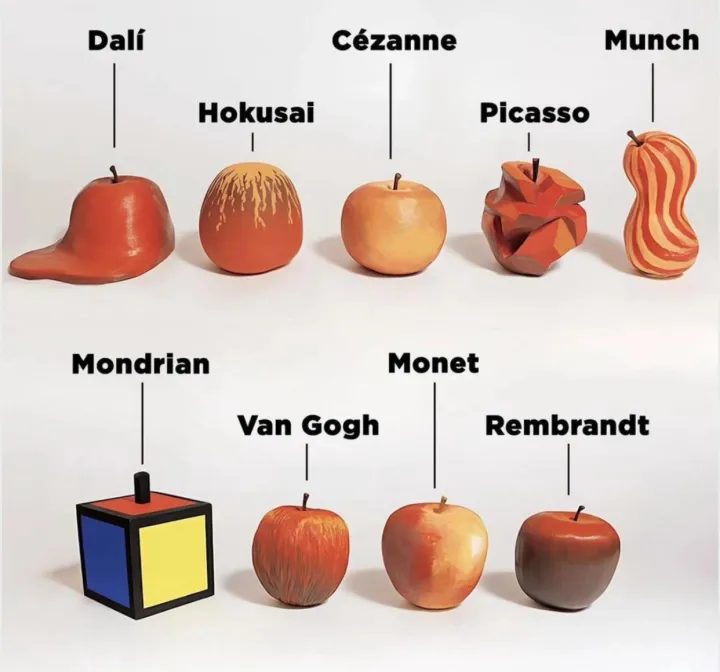
艺术启蒙并不需要复杂的工具,
怎么一秒区分梵高、莫奈、毕加索的作品?
答案居然是······一颗苹果!
1. Salvador Dalí and Surrealism
1达利一超现实主义
Surrealism stands as one of the most influential movements in modern Western art and literature, and Salvador Dalí is among its most iconic figures, often hailed as a “maverick of the art world” and a “master of artistic magic.” The second generation of surrealist painters—including Pierre Roy, Yves Tanguy, René Magritte, and Paul Delvaux—each continued to expand the movement in their own distinctive ways. Through distortion, exaggeration, and dreamlike scenes, these artists explored the depths of the human subconscious, revealing the boundless possibilities of artistic expression.
超现实主义是西方现代文艺中影响最为广泛的运动之一,达利则是这一运动的代表人物之一,被誉为画坛“怪才”和“艺术魔法大师”。第二代超现实主义画家如彼埃·罗依、唐吉、马格里特、保罗·德尔沃等,也各自以独特的方式延续了这一风格。他们通过变形、夸张和梦幻的场景,探索人类潜意识的世界,展现了艺术的无限可能性。
In Dalí’s hands, the apple is no longer a simple fruit; it appears to melt like cheese, infused with the fantastical spirit of surrealism. This unique portrayal shatters conventional perceptions of reality and invites viewers into a world of dreams and hallucinations. Dalí’s paintings seem to emerge spontaneously under the control of the subconscious, blending surreal dreamscapes with bizarre environments to vividly depict the hidden landscapes of the mind.
在达利的笔下,苹果不再是普通的水果,而是如融化的奶酪一般,充满了超现实主义的魔幻色彩。这种独特的表现手法,不仅打破了人们对现实的认知,还带领观众进入了一个充满梦境与幻觉的世界。达利的画作仿佛在“潜意识的支配下自觉涌出”,他喜欢将梦境与奇特的环境结合,展现出内心深处的幻想。
2. Katsushika Hokusai and Ukiyo-e
2葛饰北斋一浮世绘
Hokusai’s depiction of the apple captures the snowy peaks atop crimson-tinted mountains with striking precision—pleasing to the eye and full of whimsical charm. As a master of ukiyo-e during Japan’s Edo period, Hokusai became renowned for his colorful woodblock prints portraying scenes of everyday life and landscapes across Japan.
北斋的苹果精准刻画了赤玉色的山巅上白雪皑皑的景象,赏心悦目又十分有趣。他是日本江户时代的浮世绘画家,他因描绘日本生活和风景的彩印而著名。
His artistic style had a profound impact on later European art. Impressionist masters such as Edgar Degas, Édouard Manet, Vincent van Gogh, and Paul Gauguin all studied and copied his works. Hokusai remains the only Japanese figure included in the “Top 100 People Who Shaped the Millennium,” a testament to his lasting influence on global culture.
北斋的绘画风格对后来的欧洲画坛影响很大,德加、马奈、梵高、高更等许多印象派绘画大师都临摹过他的作品。他还是入选“千禧年影响世界的百位名人”中的唯一的一位日本人。
3. Paul Cézanne and Post-Impressionism
3塞尚一后印象派
Paul Cézanne, a leading figure of the Post-Impressionist movement in France, is often hailed as the “father of modern art.” Alongside Vincent van Gogh and Paul Gauguin, he is regarded as one of the three great masters of Post-Impressionism. His work and ideas profoundly influenced numerous 20th-century artists and movements, particularly Cubism, establishing a theoretical foundation for modern art.
塞尚是法国后印象主义画派画家,被誉为“现代艺术之父”与梵高、高更同为“后印象派三大巨匠”。他的作品和理念影响了20世纪许多艺术家和艺术运动,尤其是立体派,成为20世纪现代艺术的理论基石。
Cézanne’s greatest contribution lies in his unprecedented analysis of color, light, and form. He broke away from traditional perspectives, dissolving conventional spatial structures into pure impressions of color. He believed that form and color were inseparable, and he depicted volume and depth through blocks of color and the modulation of warm and cool tones. His use of geometric elements to construct shapes laid the groundwork for future explorations in abstract and modernist art.
塞尚的最大成就是对色彩与明暗具有前所未有的精辟分析,颠覆了以往的视觉透视点,空间的构造被从色彩的印象里抽掉了,认为形状和色彩是不可分离的。用色块表现物象的立体和深度,利用色彩的冷暖变化造型,以及几何元素构造形象 。
4. Pablo Picasso and Cubism
4毕加索一立体主义
Pablo Picasso, a founder of modern art and the pioneer of Cubism, revolutionized the way artists approached representation. Instead of depicting the outward appearance of objects from a single, fixed perspective, Picasso introduced a new way of integrating the physical presence of an object into the canvas, merging the depiction of tangible forms with abstract structural expression.
毕加索是现代艺术的创始人,立体画派的鼻祖,主张不要去描绘客观物体的外表形态,而是把客观物体引入绘画,从而将表现具象的物体本身和表现抽象的结构形态综合起来。
The method of modeling he established through Cubism sought to present multiple facets of a subject simultaneously—capturing both the face and the back in a single composition—rather than adhering to the traditional, singular viewpoint.
毕加索开创的这种立体主义的造型方法,就是要通过画面同时表现人(有脸有背)的所有部分,而不是像传统画法那样以一个固定视点去表现形象。
5. Edvard Munch and Expressionism
5蒙克一表现主义
Edvard Munch, the Norwegian painter and printmaker, was a key forerunner of modern Expressionist art. His works are imbued with intense subjectivity and a pervasive mood of melancholy and emotional tension. Munch’s vivid exploration of psychological anguish profoundly influenced the development of German Expressionism in the early 20th century.
蒙克是挪威表现主义画家、版画复制匠,现代表现主义绘画的先驱。他的作品带有强烈的主观性和悲伤压抑的情调。他对心理苦闷的强烈的,呼唤式的处理手法对20世纪初德国表现主义的成长起了主要的影响。
In Munch’s interpretation, the apple takes on a distorted form with strong, dynamic lines. His paintings often revolve around existential themes such as life, death, love, fear, and loneliness. Through the use of bold, contrasting lines, vivid color blocks, and simplified, exaggerated forms, Munch powerfully expressed his inner emotional landscape.
蒙克的苹果有着扭曲的造型和强烈的线条感,他多以生命、死亡、恋爱、恐怖和寂寞等为题材。用对比强烈的线条、色块、简洁概括夸张的造型,抒发自己的感受和情绪。
6. Piet Mondrian and Geometric Abstraction
6蒙德里安—几何抽象流派
Piet Mondrian, the Dutch painter, was one of the leading figures behind the De Stijl movement and a pioneer of non-representational painting. He is renowned for his abstract compositions featuring blocks of red, yellow, and blue intersected by black lines—a style that had a profound influence on later architecture, design, and visual arts.
蒙德里安,荷兰画家,风格派运动幕后艺术家和非具象绘画的创始者之一,以红、黄、蓝的色块和线条组成的非具象画作而闻名,对后世的建筑、设计等影响很大。
Mondrian was a trailblazer of geometric abstraction, using basic geometric shapes as the fundamental elements of his work. Together with Theo van Doesburg and others, he founded the De Stijl group, advocating for what he termed “Neoplasticism” or “Nieuwe Beelding” (“New Plasticism”). Mondrian believed that art should sever its ties to the external forms of nature and instead express pure abstraction, striving for a spiritual unity between humanity and the divine—a vision we now recognize as “pure abstraction.”
蒙德里安是几何抽象画派的先驱,以几何图形为绘画的基本元素,与杜斯堡等创立了“风格派”,提倡自己的艺术“新造型主义”。他还认为艺术应根本脱离自然的外在形式,以表现抽象精神为目的,追求人与神统一的绝对境界,也就是现在我们熟知的“纯粹抽象”。
7. Vincent van Gogh and Post-Impressionism
7梵高—后印象派
Vincent van Gogh stands as one of the most remarkable artists of the 19th century, a pioneer of Post-Impressionism whose influence on 20th-century art—particularly the Fauvist and German Expressionist movements—was profound.
梵高是19世纪杰出的艺术家之一,后印象派的先驱,并深深影响了二十世纪艺术,尤其是野兽派与德国表现主义。Van Gogh’s portrayal of the apple, like his broader body of work, is bold and unrestrained, bursting with color and energy like a living bonfire. When people think of Van Gogh, three iconic images often come to mind: “Sunflowers,” “The Starry Night,” and the tragic story of “the artist who cut off his own ear.” Van Gogh loved life and embraced the warmth of the sun, yet he endured immense hardship and loneliness throughout his tumultuous journey.
梵高的苹果和他的作品一样大胆奔放,仿佛跳动的篝火 鲜亮夺目。提起梵高,人们脑海中会闪现出三个关键词“向日葵”、“星空”和“割耳朵的疯子”。他热爱生活、拥抱阳光,却也在生活里备尝艰辛。
8. Claude Monet and Impressionism
8莫奈—印象派
Claude Monet’s portrayal of the apple is infused with bold, expressive colors and enigmatic plays of light and shadow. Widely regarded as the leader of the Impressionist movement, Monet was one of its founding figures and defining representatives.
莫奈的苹果,有着浓烈奔放的色彩,谜一般的光影。他被誉为“印象派领导者”,是印象派代表人物和创始人之一。
Monet excelled at capturing fleeting effects of light and atmosphere. One of his most important stylistic innovations was his departure from traditional methods of depicting shadows and outlines. In his paintings, shadows are diffused rather than sharply defined, and contours are softened or even dissolved into the surrounding environment, creating a shimmering, transient visual experience.
莫奈擅长光与影的捕捉,他最重要的风格是改变了阴影和轮廓线的画法,在莫奈的画作中看不到非常明确的阴影,也看不到突显或平涂式的轮廓线。
9. Rembrandt van Rijn and the Dutch School
9伦勃朗—荷兰画派
Under Rembrandt’s masterful handling of light and shadow, an apple appears ripened and full of life. Rembrandt, one of the greatest painters of the 17th century, is a towering figure of the Baroque period.
伦勃朗的苹果在光影之下,像是熟透的苹果。伦勃朗是17世纪最伟大的巴洛克画家之一。He pioneered the use of what is now famously known as “Rembrandt lighting,” a technique characterized by precise triangular patches of light on the face while allowing the surrounding areas to recede into shadow. This interplay of illumination and darkness gave his works an unparalleled sense of volume, depth, and emotional intensity.
他的“伦勃朗光线”创造出强烈的光影效果,用精确的三角立体光,勾勒出人物的轮廓线,让其余部分隐藏于光暗之中,使画面更具有立体感和深度感。


