在柏林墙倒塌的次年,一位教育学者进行了一项有趣的实验:他在东柏林和西柏林分别征集了一批儿童画作,主题是”我的梦想”。令人惊讶的是,来自东柏林的画作中,太阳永远在左上角,房屋都是三角形加方形,色彩搭配高度一致;而西柏林儿童的画作则充满了天马行空的想象 – 会飞的鱼,彩色的云,倒流的河流。这个实验无意中揭示了教育的深层真相:我们所接受的教育,不仅塑造着我们的知识结构,更在塑造着我们想象力的边界。
The year after the Berlin Wall fell, an education scholar conducted an intriguing experiment: he collected children’s drawings from East and West Berlin on the theme “My Dream.” Strikingly, the East Berlin pictures always placed the sun in the top-left corner, houses were triangles atop squares, and the color schemes were highly uniform; by contrast, West Berlin children’s drawings brimmed with freewheeling imagination—flying fish, rainbow clouds, and rivers that flowed backward. The experiment inadvertently exposed a deep truth about education: what we receive in schooling shapes not only our knowledge structures but also the very boundaries of our imagination.
今天,我们站在人工智能时代的门槛上,却依然沿用着工业化时代的教育范式。当ChatGPT能够在数秒内写出符合所有应试规范的作文,当Midjourney可以生成媲美专业画师的图像,我们不得不正视一个尖锐的问题:教育的价值究竟何在?
Today, standing at the threshold of the AI era, we still cling to an industrial-age paradigm of education. When ChatGPT can produce test-perfect essays in seconds and Midjourney can create images rivaling professional illustrators, we are compelled to confront a pointed question: what is the true value of education?
第一章:标准化教育的迷思与代价 Chapter 1: The Myth and Cost of Standardized Education
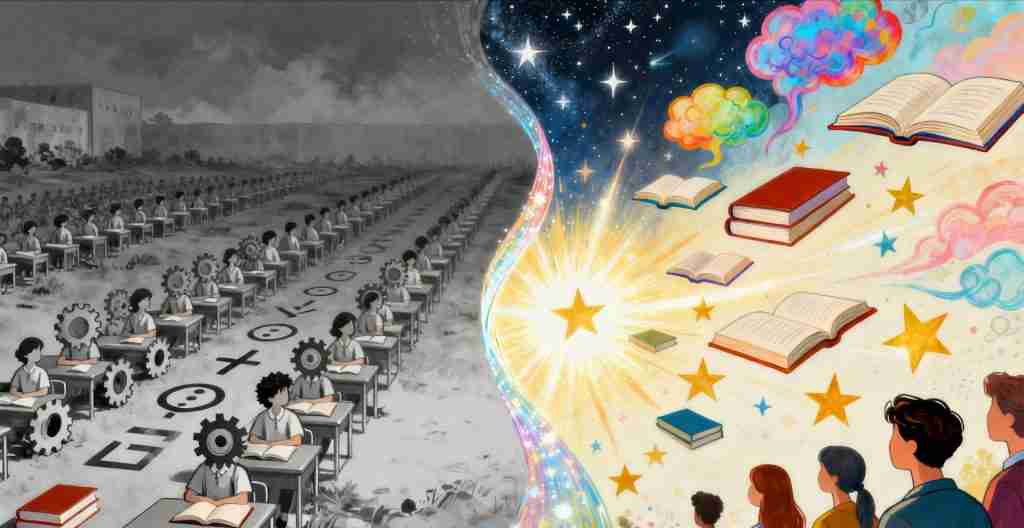
现代教育体系的雏形可以追溯到19世纪的普鲁士。当时的设计初衷非常明确:为工业化社会培养服从纪律、掌握基本技能的劳动者。这套系统如同一个精密的模具,将千差万别的个体塑造成标准化的”工业零件”。一个多世纪过去了,虽然教育的内容不断更新,但其底层逻辑依然深深烙印着工业时代的基因。
The modern education system can be traced to 19th-century Prussia. Its original purpose was clear: to produce disciplined workers with basic skills for an industrial society. Like a finely engineered mold, the system cast diverse individuals into standardized “industrial parts.” More than a century on, although content has evolved, the system’s underlying logic still bears the deep imprint of the industrial age.
在这个体系中,”错误”被赋予了一种近乎道德上的负面意义。从小学一年级的第一次测验开始,孩子们就接受到一个明确的信号:偏离标准答案就是失败。这种对错误的恐惧会随着年级的升高而不断强化。研究表明,一个孩子在幼儿园时期平均每天会提出上百个问题,但到了小学高年级,这个数字会骤降至个位数。不是因为他们失去了好奇心,而是因为他们学会了”安全的沉默”。
Within this system, “error” takes on an almost moral stigma. From their first primary-school quiz, children receive a clear signal: deviating from the standard answer is failure. Fear of error intensifies with each grade. Studies show that while a child in kindergarten asks hundreds of questions a day, by upper primary the number plummets to single digits—not because curiosity fades, but because they learn the art of “safe silence.”
更为深层的影响发生在认知结构的层面。标准化教育实际上是在训练一种”聚合思维” – 将所有的思考路径都导向唯一正确的答案。这种思维方式在应对明确规则的问题时非常高效,但在面对真实世界的复杂挑战时却显得力不从心。这就是为什么我们培养出了大量能够在奥数竞赛中摘金夺银的天才,却在科技创新领域面临原创性不足的困境。
A deeper impact unfolds within our cognitive architecture. Standardized education trains “convergent thinking”—funneling all thought paths toward a single correct answer. This approach excels where rules are explicit, yet falters before the complex challenges of real life. Hence, we produce many prodigies who triumph in math Olympiads, while confronting a persistent shortfall of originality in technological innovation.
第二章:创造力危机的多维呈现 Chapter 2: The Multidimensional Face of the Creativity Crisis
在全球范围内,教育体系正在经历一场无声的创造力危机。经济合作与发展组织(OECD)的最新教育报告指出,尽管各国学生在PISA测试中的表现逐年提升,但他们的创新能力和问题解决能力却没有同步增长。这种”高分低创造”的现象在东亚教育体系中尤为明显。
Worldwide, education systems are undergoing a silent creativity crisis. Recent OECD reports note that while PISA scores have steadily improved, students’ innovation and problem-solving abilities have not kept pace. This “high scores, low creativity” pattern is especially pronounced in East Asian systems.
以中国的教育实践为例,语文考试的阅读理解题常常成为社会讨论的热点。令人困惑的是,这些题目的”标准答案”有时连文章的作者本人都无法完全匹配。这种荒诞的现象揭示了标准化教育的深层困境:当我们过度追求可量化的评估标准时,实际上是在用简化的工具来衡量复杂的心智活动。 Consider China’s language exams, where reading-comprehension items frequently spark public debate. Puzzlingly, the “standard answers” sometimes diverge even from the authors’ own interpretations. This absurdity exposes a deeper quandary: by over-privileging quantifiable metrics, we use simplified tools to measure profoundly complex mental activity.
神经科学的研究为我们提供了更深入的视角。大脑中负责创造性思维的默认模式网络与负责专注执行任务的中央执行网络存在着某种拮抗关系。这意味着,当我们过度强化规则导向的思维模式时,实际上是在抑制大脑创造性神经网络的发展。这或许可以解释为什么那些最严格遵守课堂纪律、最精准复现知识点的”好学生”,在需要突破性创新的场景中往往表现平平。
Neuroscience adds nuance: the brain’s Default Mode Network (linked to creative thought) stands in a counterbalancing relationship with the Central Executive Network (task execution). Over-reinforcing rule-driven thinking can suppress development of neural pathways for creativity. This may explain why students who best obey classroom norms and perfectly reproduce content often underperform in contexts demanding breakthrough innovation.
第三章:教育范式的战略转向 Chapter 3: A Strategic Shift in Educational Paradigms
面对人工智能时代的挑战,教育的转型不再是可选项,而是必然选择。这场转型的核心是从”知识传授”转向”潜能激发”,从”标准化培养”转向”个性化发展”。
Confronted by the AI era, educational transformation is not optional but imperative. At its core, this shift moves from “knowledge transmission” to “potential activation,” and from “standardized training” to “personalized development.”
首先,我们需要重新定义教育的核心使命。 在知识获取变得越来越便捷的时代,教育的价值应该从”知道什么”转向”能创造什么”。新加坡的Tree Art美育机构在这方面提供了有益的启示。他们的课程设计不追求技法的标准化,而是注重激发每个孩子独特的表达方式。在这里,重要的不是画得像不像,而是是否表达了真实的感受和想象。这种教育理念的转变,实际上是从”技术传授”到”心灵唤醒”的升华。
First, we must redefine education’s core mission. In an age where knowledge is ever easier to access, the value of education should pivot from “what you know” to “what you can create.” Tree Art in Singapore offers a useful example: its curriculum eschews technique standardization and instead nurtures each child’s unique mode of expression. What matters is not resemblance to reality, but the authenticity of feeling and imagination. This shift marks an elevation from “teaching technique” to “awakening the inner life.”
其次,评价体系的改革是转型的关键支点。 单一维度的标准化考试必须让位于多元化的评估体系。这个体系应该能够捕捉到学生在不同情境下展现出的各种能力:协作能力、批判性思维、艺术表达、社会责任感等。芬兰的教育改革实践表明,当评估的重点从结果转向过程,从统一标准转向个人成长轨迹时,学生的学习动机和创新潜力会得到显著释放。
Second, assessment reform is the pivotal lever. One-dimensional standardized tests must yield to diversified evaluation systems capturing capabilities across contexts: collaboration, critical thinking, artistic expression, and social responsibility. Finland’s reforms show that when emphasis shifts from results to process, and from uniform benchmarks to individual growth trajectories, students’ motivation and innovative potential are markedly unleashed.
第三,课程设计需要打破传统的学科界限。 项目式学习(PBL)应该成为教育的新常态。在一个典型的环境保护项目中,学生需要同时运用科学知识分析环境问题,使用数学工具处理数据,通过艺术表达传播理念,借助文学才能撰写倡议书。这种学习方式不仅更接近真实世界的工作模式,更重要的是培养了学生整合不同领域知识解决复杂问题的能力。
Third, curriculum must transcend traditional subject silos. Project-Based Learning (PBL) should become the new normal. In a typical environmental project, students apply science to analyze issues, use mathematics to handle data, employ art to communicate ideas, and leverage writing to craft advocacy. Beyond mirroring real-world work, this cultivates the capacity to integrate knowledge across domains to solve complex problems.
第四章:未来教育的三大战略支柱 Chapter 4: Three Strategic Pillars for Future Education
面向未来的教育体系应该建立在三个核心支柱之上:个性化、创造力和心智自由。
A future-ready education system should rest on three core pillars: personalization, creativity, and freedom of mind.
个性化教育意味着承认每个孩子都是独一无二的生命个体。加德纳的多元智能理论告诉我们,人类至少存在八种不同的智能类型。传统的学校教育只重点关注了其中的语言和逻辑数学智能,而忽视了空间智能、音乐智能、人际智能等其他重要的能力维度。未来的教育应该像精准医疗一样,为每个学生量身定制成长路径。
Personalized education recognizes each child as a singular human being. Gardner’s Multiple Intelligences theory posits at least eight distinct intelligences. Traditional schooling privileges linguistic and logical-mathematical forms while overlooking spatial, musical, interpersonal, and others. Future education should, like precision medicine, tailor growth pathways to each learner.
创造力培养需要从软技能升级为核心素养。这要求我们重新设计学习环境,使其更有利于创造性思维的涌现。谷歌公司的”20%时间”政策(允许员工将20%的工作时间用于自主项目)在教育领域同样具有启示意义。给学生足够的自主探索空间,他们往往会带来令人惊喜的创新成果。 Creativity must be elevated from a “soft skill” to a core competency. This calls for redesigning learning environments to foster creative emergence. Google’s “20% time” policy—allocating one-fifth of work time to self-directed projects—offers inspiration for schools: grant students genuine autonomy, and unexpected innovations often follow.
心智自由的守护是教育最本质却又最容易被忽视的使命。一个心智自由的人能够突破常规思维的束缚,保持对世界的好奇和质疑的勇气。这种品质在信息爆炸的时代显得尤为珍贵。正如哲学家雅斯贝尔斯所言:”教育的本质是唤醒,而非塑造。
” Safeguarding freedom of mind is education’s most essential yet most neglected mission. A mind that is free can break habitual constraints and sustain curiosity and courageous questioning—qualities especially precious in an age of information deluge. As philosopher Karl Jaspers observed, “The essence of education is awakening, not molding.”
第五章:实施路径与行动倡议 Chapter 5: Pathways and Calls to Action
推动如此深刻的教育变革需要系统性的努力。以下是一些可行的实施路径:
Driving such profound change demands systemic effort. The following pathways are actionable:
对政策制定者而言,需要打破对标准化考试的路径依赖,建立更加多元的教育质量评估体系。同时,应该给予学校和教师更大的课程创新自主权,鼓励教育实践的多样性。
For policymakers: break the path-dependence on standardized testing and build more plural metrics for educational quality. Grant schools and teachers greater autonomy for curricular innovation to encourage diverse practices.
对教育机构而言,转型的关键在于教师队伍的建设。未来的教师不应该只是知识的传授者,更应该是学习的引导者、成长的陪伴者和潜能的发现者。这要求教师教育体系进行相应的改革。 For institutions: the key lies in teacher development. Future educators should be not merely transmitters of knowledge but facilitators of learning, companions in growth, and discoverers of potential—necessitating reforms in teacher education.
对家长和社会而言,需要破除”唯分数论”的成功观念。一个孩子的价值不应该被简化为试卷上的数字,而应该从他独特的个性、丰富的潜力和对生活的热情等多个维度来考量。
For parents and society: dismantle score-centric notions of success. A child’s worth is not reducible to marks on a paper; it should be seen through the lenses of individuality, potential, and passion for life.
值得期待的是,科技创新正在为教育转型提供新的可能。自适应学习系统能够根据每个学生的学习进度动态调整教学内容,虚拟现实技术可以创造出身临其境的学习体验,区块链技术为学习成果的认证提供了新的思路。这些技术如果运用得当,将有力推动教育向更加个性化、创造性的方向发展。 Encouragingly, technological innovation opens new avenues: adaptive systems tune content to each learner’s pace; virtual reality enables immersive experiences; blockchain suggests novel models for credentialing. Used judiciously, these tools can propel education toward greater personalization and creativity.
结语:走向新的教育图景 Conclusion: Toward a New Educational Landscape
站在文明演进的角度看,教育从来都是一个时代最深刻的镜像。农业文明时代,教育是特权阶层传承文化的奢侈品;工业文明时代,教育是规模化培养劳动力的标准化生产线;而在智能文明时代,教育应该成为唤醒每个生命独特潜能的艺术。
Viewed through the evolution of civilization, education has always mirrored its age. In agrarian times, it was a luxury of cultural transmission for elites; in the industrial era, a standardized assembly line for producing labor. In the age of intelligence, it should become the art of awakening each life’s unique potential.
这不是一场温和的改良,而是一次深刻的教育范式革命。它要求我们重新思考教育的本质、价值和实践方式。这场变革的最终目标,是让教育从压抑创造力的枷锁转变为释放人类潜能的催化剂。
This is not a gentle reform but a paradigm revolution. It calls us to rethink education’s essence, value, and practice. Its ultimate aim is to transform education from a shackle on creativity into a catalyst for human potential.
当我们能够真正尊重每个孩子的独特性,当他们不必担心”错误”的惩罚,当他们被鼓励追随自己的好奇和热情,人类文明的创造力之泉将重新喷涌。在那样的教育图景中,我们将培养出不仅能够适应未来,更能够创造未来的新一代。
When we truly honor each child’s uniqueness, free them from the fear of “wrongness,” and encourage them to pursue curiosity and passion, the wellspring of human creativity will flow anew. In that vision of education, we will nurture a generation that not only adapts to the future but creates it.
在这个意义上,重塑教育不仅是一项社会工程,更是我们对人类文明未来的最深刻承诺。让我们共同期待并致力于这样一个未来:在那里,教育不再是标准化的荒野,而是让每个生命都能绽放独特光彩的星辰大海!
In this sense, remaking education is not merely a social project; it is our deepest commitment to the future of human civilization. Let us work toward a future where education is no longer a standardized wasteland, but an ocean of stars in which every life can shine with its own light!


